A Night When Anfield Remembered What It Means to Believe
There are football matches at Anfield, and then there are Anfield nights; those rare evenings when the floodlights seem to hum, the banners ripple in rhythm, and the belief becomes something almost tangible. On November 4, 2025, Liverpool hosted Real Madrid in the UEFA Champions League and produced one of those nights. It wasn’t a thrashing or a goal fest, but a contest of control, defiance, and a return to everything the club has long stood for.
Liverpool’s 1–0 victory over Real Madrid was more than a group-stage result. It was a statement of renewal. Alexis Mac Allister’s header just after the hour mark gave Arne Slot’s side the win, but the evening belonged to Conor Bradley, the young Northern Irish right-back who turned in the performance of his life against one of football’s most feared wingers, Vinícius Júnior.
This wasn’t just a tactical triumph; it was a coming-of-age story played out on one of football’s most storied stages.
The Stakes and the Shadows
Liverpool entered the game under quiet pressure. October had been turbulent: draws, dropped points, and questions about consistency had crept into the narrative surrounding Slot’s early months in charge. The Dutchman’s philosophy: measured, structured, and possession-oriented was beginning to show signs of cohesion, but results had not always reflected the effort.
Real Madrid, by contrast, arrived in familiar fashion. Unbeaten in Europe, dripping in confidence, and carrying the psychological edge of recent history, they had become Liverpool’s perennial tormentors. The ghosts of Paris 2022 and the knockout defeat the following year still lingered. To beat Madrid wasn’t just to earn three points; it was to exorcise those lingering doubts.
Slot’s task was simple on paper but immense in execution: restore belief, reassert identity, and show that his Liverpool could compete with Europe’s elite. By the final whistle, all three boxes were ticked.
A Match of Margins and Moments
The game itself unfolded like a chess match, each side probing for weakness without overextending. Liverpool were organized, patient, and precise. Their pressing wasn’t wild; it was surgical. Real Madrid, ever the aesthetes, relied on quick switches and the technical authority of Camavinga and Bellingham to control tempo.
But while Madrid controlled phases of possession, Liverpool controlled the narrative. Every duel, every interception, every block carried significance. The defining moment came in the 61st minute when Dominik Szoboszlai’s whipped free-kick found Mac Allister rising between defenders to head past Thibaut Courtois. The roar that followed wasn’t just joy; it was relief, a release of tension, frustration, and fear.
Still, it was what happened before and after that goal that truly defined the evening. For throughout the ninety minutes, on Liverpool’s right flank, a quiet storm was brewing; one that would eventually steal every headline.
Facing the Fire: Bradley vs Vinícius
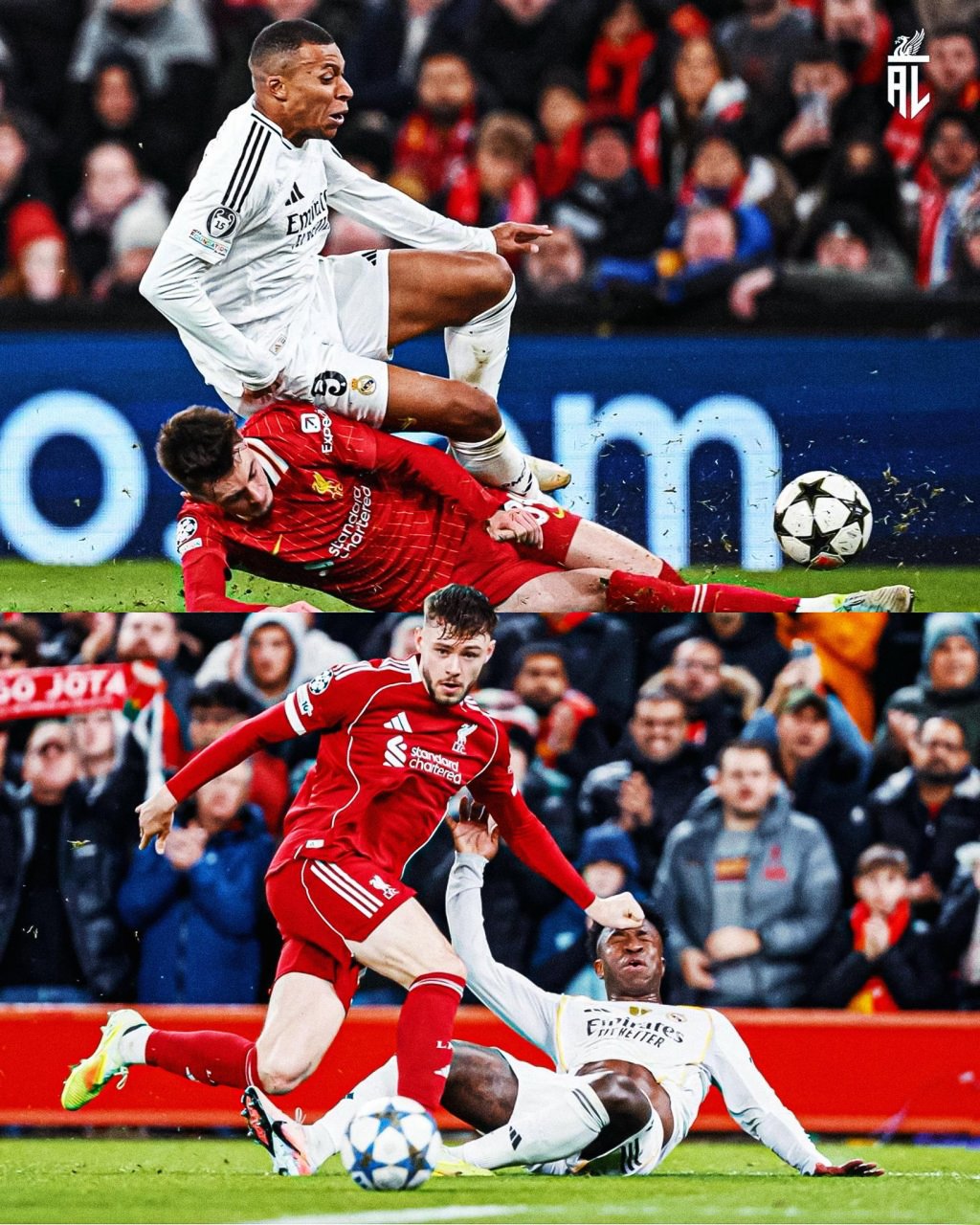
Vinícius Júnior has built a reputation as one of the deadliest one-on-one wingers in world football. He thrives on chaos, rapid accelerations, flicks of misdirection, and bursts of pure improvisation that shred defensive lines. Against him stood a 22-year-old full-back from Castlederg, County Tyrone, with barely a handful of Champions League appearances to his name.
It looked, on paper, like a mismatch. It wasn’t.
From the first whistle, Conor Bradley exuded calm. He didn’t dive in, didn’t flinch, and didn’t play the occasion. He simply read the game. Time after time, Vinícius tried to draw him into traps; feints inside, quick darts to the line, but Bradley anticipated almost everything. His positional sense was impeccable. When Madrid switched play, he was already there, cutting off the angle, ushering the ball away from danger.
At one point early in the second half, Vinícius tried to exploit space behind him. Bradley matched him stride for stride, waited for the perfect moment, and used his body to shepherd the ball out of play. The Kop’s reaction was thunderous. It sounded like a goal had been scored.
Moments like that define reputations. Against the same opponent who had tormented Trent Alexander-Arnold in previous seasons, Bradley looked immovable. It was as if the stage brought out the best of his steel and composure.
Composure Beyond His Years
What made Bradley’s performance special wasn’t only his defensive solidity, but the serenity with which he played. In an environment that has swallowed many young players whole, he was unflappable. His timing in the tackle was perfect. His awareness of space was mature. His recovery runs were timed as if guided by instinct rather than reaction.
By the end of the match, Vinícius looked like he had lost all hope. Bradley’s presence had an intangible quality, the kind that makes teammates stand taller.
A Symbol of Slot’s Liverpool
In many ways, Bradley’s display was the purest embodiment yet of Arne Slot’s vision for Liverpool. The Dutchman has sought to blend structure with spirit, to maintain the high-energy DNA of Klopp’s era while adding positional balance and technical precision.
Bradley epitomized that balance. His aggression was measured. His discipline was absolute. He knew when to press and when to pause. He didn’t simply react; he anticipated. In a system where positional intelligence is everything, he looked utterly at home.
For Slot, this was vindication. It showed that his faith in youth and in preparation was justified. For Bradley, it was confirmation that he belongs not as a fringe player or deputy, but as a genuine first-team force.
The Northern Irish Steel
Conor Bradley’s journey to this point wasn’t one of overnight acclaim. Born in Castlederg, a small town in Northern Ireland, his path to Anfield stardom was built on graft rather than glamour. He joined Liverpool’s academy at sixteen, quiet and unassuming, known for his work rate and discipline rather than flair.
His breakout came during a loan spell at Bolton Wanderers, where he played over forty matches, won the club’s Player of the Year award, and learned the art of defending in the most unforgiving environments of English League One. That experience hardened him, refined his timing, and sharpened his tactical instincts.
Those who worked with him there often said the same thing: Bradley was the type of player who improved with responsibility. Give him a task, however difficult, and he would find a way to meet it.
And so it was at Anfield. On a stage dripping with history, against one of the world’s best, he showed that same steel, that same quiet defiance that has defined his rise.
Echoes of Past Heroes
Bradley’s performance stirred memories of other defenders forged in Anfield’s furnace. There was a touch of Steve Finnan’s understated consistency in the way he handled danger. There were echoes of Jamie Carragher’s defiant blocking and will to win. And, inevitably, there was the comparison to Trent Alexander-Arnold—the man whose shadow he has long worked beneath.
It’s hard to deny that Trent has revolutionized what it means to be a modern full-back: creative, expressive, attacking. Bradley represents the complementary opposite; a reminder that defending itself can still be an art. His ability to shut down elite wingers offers Liverpool a tactical alternative: the option to choose solidity over spectacle when the situation demands it.
That versatility could be crucial in the months ahead, and for a young player still finding his voice, there’s something powerful in carving a different path rather than imitating someone else’s.
From Promise to Proven
In football, there’s a fragile line between potential and proof. Many players flirt with it; few cross it decisively. Conor Bradley crossed it under the floodlights of Anfield, in a match that demanded courage, intelligence, and calm. He didn’t just survive; he excelled.
What began as a test became a transformation. The right-back who once waited quietly in the wings has now announced himself to Europe. His performance was a blueprint in modern defending—measured, efficient, and utterly fearless.
He may wake up tomorrow still the same soft-spoken kid from Castlederg, but the football world will not see him that way again.
 Anything Liverpool
Leave a comment